
 ,
Victor Metang*,
Zenon Itiga,
Danielle Christiane Ananga Olomo,
Lucien Paul Bamagalena,
Boris Tchouta Toyi,
Lucie Jenny Eyimi,
Berthol Manfo Yemkeu
,
Victor Metang*,
Zenon Itiga,
Danielle Christiane Ananga Olomo,
Lucien Paul Bamagalena,
Boris Tchouta Toyi,
Lucie Jenny Eyimi,
Berthol Manfo Yemkeu
Several diverse models and hypotheses have been proposed to understand the dynamics of the Central African Pan-African Belt. The lack of agreement among these proposals suggests that it would be better to continue large scale mapping to provide answers to this regional issue. In this perspective, the NE-SW oriented Yandingui-Yangba rock massif, located about thirty kilometers north of Bafia, and intrudes a Precambrian metamorphic basement. The petrographic study of the massif reveals two lithological units: the metamorphic unit, which includes orthogneiss and amphibolite enclaves, and the intrusive magmatic unit, composed of amphibole-biotite granites. Geochemically, the rocks of Yandingui-Yangba (67.85 < SiO2 < 71.06) are metaluminous I-type granites (A/CNK < 1.1), associated with the shoshonitic series and of magnesian nature (0.67 < FeOt/(MgO + FeOt) < 0.78). Mantle-normalized trace element spectra show a subparallel pattern between the granites and orthogneiss, indicating a common origin. These rocks were emplaced in a volcanic arc setting in a subduction-collision context. The presence of positive anomalies in U, K, Pb, and Zr, and negative anomalies in Th, Nb, and Ti, is characteristic of crustal-derived rocks. The magma that generated these granites resulted from the partial melting of metagreywackes in the lower crust, as evidenced by the low concentrations of Ni and Cr. This melting was likely facilitated by heat influx from mantle-derived magma during the Pan-African orogeny.
| Published in | Earth Sciences (Volume 14, Issue 3) |
| DOI | 10.11648/j.earth.20251403.11 |
| Page(s) | 93-104 |
| Creative Commons |
This is an Open Access article, distributed under the terms of the Creative Commons Attribution 4.0 International License (http://creativecommons.org/licenses/by/4.0/), which permits unrestricted use, distribution and reproduction in any medium or format, provided the original work is properly cited. |
| Copyright |
Copyright © The Author(s), 2025. Published by Science Publishing Group |
Granites, Orthogneiss, Enclave, Shoshonitic, I-Type, Pan-African, Yandingui-Yangba
Biotite and amphibole orthogneisses | amphibolites | Biotite and amphibole granites | ||||||||||||
|---|---|---|---|---|---|---|---|---|---|---|---|---|---|---|
ND17 | ND7 | ND19 | ND9 | ND15 | ND16 | ND22 | ND23 | ND11 | ND12 | ND14 | ND1 | ND2 | ND6 | |
SiO2 | 69.97 | 64.98 | 69.92 | 49.06 | 70.03 | 71.06 | 67.85 | 70.61 | 70.05 | 73.05 | 77.09 | 71.71 | 71.48 | 70.43 |
TiO2 | 0.46 | 0.61 | 0.87 | 1.41 | 0.33 | 0.29 | 0.56 | 0.28 | 0.39 | 0.39 | 0.20 | 0.25 | 0.29 | 0.31 |
Al2O3 | 14.84 | 15.35 | 12.34 | 14.01 | 14.33 | 13.93 | 14.09 | 14.97 | 14.69 | 13.08 | 11.48 | 13.61 | 13.59 | 13.79 |
Fe2O3 | 3.00 | 5.40 | 6.59 | 13.34 | 2.42 | 2.17 | 3.83 | 2.17 | 2.72 | 2.11 | 1.88 | 2.03 | 2.73 | 2.55 |
MnO | 0.05 | 0.13 | 0.12 | 0.22 | 0.05 | 0.05 | 0.08 | 0.03 | 0.07 | 0.05 | 0.01 | 0.06 | 0.06 | 0.06 |
MgO | 1.29 | 2.22 | 0.55 | 7.39 | 0.59 | 0.47 | 1.10 | 0.52 | 0.90 | 0.63 | 0.02 | 0.36 | 0.44 | 0.62 |
CaO | 3.20 | 3.81 | 2.77 | 10.62 | 1.45 | 1.28 | 2.20 | 1.71 | 1.52 | 1.59 | 0.43 | 1.72 | 1.19 | 1.57 |
Na2O | 4.12 | 4.95 | 2.20 | 2.33 | 3.88 | 3.44 | 3.35 | 3.65 | 4.03 | 3.34 | 2.98 | 2.72 | 3.24 | 3.17 |
K2O | 2.17 | 1.58 | 4.17 | 0.78 | 6.16 | 6.63 | 6.41 | 5.51 | 5.12 | 4.68 | 5.16 | 7.20 | 6.59 | 6.91 |
P2O5 | 0.11 | 0.16 | 0.23 | 0.13 | 0.08 | 0.07 | 0.14 | 0.11 | 0.10 | 0.15 | 0.01 | 0.06 | 0.07 | 0.08 |
Tot | 99.21 | 99.19 | 99.76 | 99.29 | 99.32 | 99.39 | 99.61 | 99.56 | 99.59 | 99.07 | 99.26 | 99.72 | 99.68 | 99.49 |
L.O.I. | 1.66 | 0.78 | 0.56 | 1.18 | 0.45 | 0.50 | 0.42 | 0.72 | 1.73 | 0.43 | 0.30 | 0.87 | 0.61 | 0.51 |
S | 339 | 51 | 58 | 63 | 22 | 11 | 28 | 28 | 20 | 36 | <10 | 53 | 21 | 27 |
Sc | <5 | <5 | 25 | 26 | <5 | 12 | 12 | <5 | 10 | 9 | 9 | 8 | 12 | 6 |
V | 37 | 72 | 14 | 284 | 23 | 15 | 40 | 30 | 31 | 29 | <5 | 17 | 25 | 24 |
Cr | 30 | 24 | <6 | 171 | <6 | <6 | 15 | <6 | 14 | <6 | <6 | <6 | 17 | <6 |
Co | 55 | 152 | 154 | 91 | 126 | 231 | 162 | 144 | 199 | 205 | 236 | 170 | 211 | 144 |
Ni | 14 | 21 | 3 | 70 | 8 | 6 | 14 | <3 | 10 | <3 | <3 | 5 | 10 | 11 |
Cu | 53 | 59 | 32 | 83 | 42 | 15 | 25 | 26 | 31 | 19 | 22 | 19 | 22 | 19 |
Zn | 40 | 86 | 118 | 116 | 39 | 25 | 61 | 20 | 42 | 29 | 94 | 15 | 37 | 36 |
Ga | 24 | 31 | 26 | 24 | 23 | 22 | 25 | 23 | 23 | 22 | 25 | 20 | 23 | 23 |
Rb | 53 | 105 | 135 | 20 | 113 | 127 | 174 | 128 | 155 | 136 | 130 | 206 | 152 | 166 |
Sr | 470 | 519 | 162 | 348 | 623 | 619 | 771 | 742 | 461 | 347 | 28 | 542 | 622 | 611 |
Y | 14 | 17 | 85 | 31 | 18 | 14 | 22 | 9 | 24 | 24 | 43 | 19 | 21 | 20 |
Zr | 146 | 122 | 454 | 71 | 183 | 179 | 242 | 104 | 163 | 184 | 363 | 163 | 193 | 181 |
Nb | 4 | 9 | 28 | 5 | 8 | 7 | 13 | 3 | 11 | 15 | 8 | 10 | 8 | 8 |
Ba | 964 | 370 | 1325 | 286 | 2536 | 2547 | 2764 | 2191 | 1826 | 782 | 332 | 2786 | 2840 | 2857 |
La | 33 | 28 | 99 | <10 | 19 | 23 | 22 | <10 | 16 | 24 | 45 | 17 | 20 | 25 |
Ce | 65 | 66 | 209 | <10 | 81 | 95 | 104 | 65 | 105 | 100 | 84 | 85 | 103 | 87 |
Nd | <10 | 26 | 25 | 16 | <10 | <10 | <10 | <10 | <10 | <10 | 33 | <10 | <10 | <10 |
Pb | 29 | 31 | 32 | 17 | 47 | 40 | 47 | 52 | 52 | 40 | 36 | 54 | 45 | 49 |
Th | 5 | 9 | 13 | 3 | <3 | <3 | <3 | <3 | 4 | 8 | 9 | <3 | <3 | <3 |
U | 3 | 8 | 7 | 4 | 9 | 7 | 7 | 9 | 8 | 10 | 11 | 9 | 11 | 12 |
A/CNK | Al2O3 / (CaO+NaO+K2O) |
| [1] | Altherr, F. F., Holl, A., Hegner, E., Langer, C., Kreuzer, H., 2000. High-potassium, calc-alkaline I-type plutonism in the European variscides: Northern Vosges (France) and northern Schwarzwald (Germany). Lithos 50, pp. 51-73. |
| [2] | Chappell, B. W., White, A. J. R., 1992. I- and S-type granites in the Lachlan Fold Belt: Transactions of the Royal Society of Edinburgh. Earth Sciences 83, pp. 1-12. |
| [3] | Cox, K. G., Bell, J. D., Pankhurst, R. J., 1979. The Interpretation of Igneous Rocks. Georges, Allen and Unwin, London, p. 450. |
| [4] | Djouka, F., Schul, B., Schussler, U., Tchouankoué, J. P., Nzolang, C., 2008. Geochemistry of the Bafoussam Pan-African I- and S-type granitoids in western Cameroon. Journal of African Earth Sciences 50, pp. 148-167. |
| [5] | Frost, C. D., O' Nions, R. K., 1985. Caledonian magma genesis and crustal recycling. Journal of Petrology 26, pp. 515–544. |
| [6] | Frost, B. R., Barnes, C. G., Collins, W. J., Arculus, R. J., Ellis, D. J., Frost, C. D., 2001. A geochemical classification for granitic Rocks. J. Petrol. 42, 2033-2048. |
| [7] | Ganno, S., Nzenti, J-P., Ngnotué, T., Kankeu B., Kouankap Nono, G. D., 2010. Polyphase deformation and evidence for transpressive tectonics in the Kimbi area, Northwestern Cameroon Pan-African Fold Belt. Journal of Geology and Mining Research 4 (2), 1-15. |
| [8] | Ganwa, A. A., 1998. Contribution à l’étude géologique de la région de Kombé II-Mayabo dans la Série de Bafia: géomorphologie structurale, tectonique, pétrologie. Thèse Université de Yaoundé I, 193 p. |
| [9] | Kay, R. W., Mahlburgkay, S., 1991. Creation and destruction of lower continental crust. International Journal of Earth Sciences 80, pp 259-278. |
| [10] | Kwékam, M., Affaton, P., Bruguier, O., Liégeois, J. P., Hartmann, G., & Njonfang, E., 2013. The Pan-African Kekem gabbro-norite (West-Cameroon), U-Pb zircon age, geochemistry and Sr-Nd isotopes: Geodynamical implication for the evolution of the Central African fold belt. Journal of African Earth Sciences 84, 70-88. |
| [11] | Kwékam, M., Hartmann, G., Njanko, T., Tcheumenak Kouémo, J., Fozing, E, M., Njonfang, E., 2015. Geochemical and isotope Sr-Nd character of Dschang biotite granite: implications for the Pan-African continental crust evolution in West-Cameroon (Central Africa). Journal of African Earth Sciences 4, 88-102. |
| [12] | Kwékam, M., Liégeois, J. P., Njonfang, E., Affaton, P., Hartmann, G., Tchoua, F., 2010. Nature, origin and significance of the Fomopéa Pan-African high-K calc-alkaline plutonic complex in the Central African fold belt (Cameroon). Journal of African Earth Sciences 54, 79-95. |
| [13] | Liégeois, J. P., Abdelsalam, M. G., Ennih, N., Ouabadi, A., 2013. Metacraton: Nature, genesis and behavior. Gondwana Research 23, 220-237. |
| [14] | Liégeois, J. P., Navez, J., Hertogen, J., Black, R., 1998. Contrasting origin of post-collisional high-Kcalc-alkaline and shoshonotic versus alkaline and peralkaline granitoids. The use of sliding normalization, Lithos 45, 1-28. |
| [15] |
Maniar, P. D., Piccoli P. M., 1989. Tectonic discrimination of granitoids. Geological society of America Bulletin 101, 635-643.
https://doi.org/10.1130/0016-7606(1989)101<0635:TDOG>2.3.CO;2 |
| [16] | Mbassa, J. B., Kamgang, P., Njonfang, M. E., Zenon, Itiga, B., Duchene, S., Bessong, M., Wonkwenmendam Nguet, P., Ntepe Nfomou., 2016. Evidence of heterogeneous crustal origin for the Pan-African Mbengwi granitoids and the associated mafic intrusions (northwestern Cameroon, central Africa). Comptes Rendus Geosciences 348, 116-126. |
| [17] | Miyashiro, A., 1978. Nature of Alkalic Volcanic Rock Series. Contribution to Mineralogy and Petrology 66, 91-104. |
| [18] | Ngako, V., Affaton, P., Njonfang, E., 2008. Pan-African tectonics in northwestern Cameroon: implication for the history of western Gondwana. Gondwana Research 14: 509-522. |
| [19] | Ngako, V., Njonfang, E., 2011. Plates Amalgamation and Plate Destruction, the Western Gondwana History. Tectonics. Dr. Damien Closson (Ed.), ISBN 978-953-307-545-7, InTech. |
| [20] | Ngamy Kamwa, A., Tchakounte Numbem, J., Nkoumbou, C., Owona, S., Tchouankoue, J. P., Mvondo Ondoa, J., 2019. Petrology and geochemistry of the Yoro-Yangben Pan-African granitoids intrusion in the Archean Adamawa-Yade crust (Sw-Bafia, Cameroon). Journal of African Earth Sciences 150, 401-414. |
| [21] | Ngo Belnoun, R. N., Tchouankoué J. P., Zenon Itiga., Simeni Wambo N. A., Owona S., Koller F., Thöni, M., 2013. Geochemistry of the bayon plutonic complex -western Cameroon. Global Journal of Geological Sciences 11, pp. 73-93. |
| [22] | Njanko, T., 1999. Les Granitoïdes calco-alcalins syn-cisaillement de la région de Tibati (domaine Centre de la Chaine Panafricaine): leur signification géodynamique par rapport à la tectonique Panafricaine. Thèse Doctorat 3ème cycle, Université de Yaoundé I, 158 p. |
| [23] | Nkoumbou, C., Barbey, P., Yonta-Ngouné, C., Paquette, J. L., Villiéras, F., 2014. Precollisional geodynamic context of the southern margin of the Pan-African fold belt in Cameroon. Journal of African Earth Sciences 99: 245-260. |
| [24] | Nzenti, J. P., 1998. L’Adamaoua Panafricain (région de Banyo) : une zone clé pour un modèle de la Chaine Panafricaine Nord- Équatoriale au Cameroun. Thèse Doctorat d’État, Université Cheikh AntaDiop-Universite de Nancy I, 176 p. |
| [25] | Nzenti, J. P., Abaga, B., Suh, C. E., Nzolang, C. 2010. Petrogenesis of peraluminous magmas from the Akum-Bamenda Massif, Pan-African Fold Belt, Cameroon. International Geology Review, pp. 1- 29. |
| [26] | Nzenti, J. P., Barbey, P., Bertrand, J. M. I., Macaudiere, J., 1994. La Chaine Panafricaine au Cameroun : cherchons suture et modelé. Société Géologique de France 15, réunion des Sciences de la Terre, Nancy, France, 99 p. |
| [27] | Nzenti, J. P., Barbey,, P., Macaudiere, J., Soba, D., 1988. Origin and evolution of late Precambrian high-grade Yaoundé gneisses (Cameroon). Precambrian Research 38, pp. 91-109. |
| [28] | Nzenti, J. P., Barbara, Abaga., Suh, C. E., Nzolang, C., 2011 : Petrogenesis of peraluminous magmas from the Akum-Bamenda Massif, Pan-African Fold Belt, Cameroon. International Geology Review 53, pp 1121-1149. |
| [29] | Nzolang, C., Kagami, H., Nzenti, J. P., Holtz, F., 2003. Geochemistry and preliminary Sr–Nd isotopic data on the Neoproterozoic granitoids from the Bantoum area, West Cameroon: evidence for a derivation from a Paleoproterozoic to Archean crust. Polar Geoscience Tokyo 16, 196-226. |
| [30] | Oliveira, E. P., Toteu, S. F., Araújo, M. N. C., Carvalho, M. J., Nascimento, R. S., Bueno, J. F., McNaughton, N., Basilici, G., 2006. Geologic correlation between the Neoproterozoic Sergipano Belt (NE Brazil) and the Yaoundé Belt (Cameroon, Africa). Journal of African Earth Sciences 44, 470-478. |
| [31] | Pearce, J. A., Harris, N. B. W., Tindle, A. G., 1984. Trace elements discrimination diagrams for the geotectonic interpretation of granite rocks. Journal of petrology 25, 956-983. |
| [32] | Peccerillo, A., Taylor, S. R., 1976. Geochemistry of Eocene Calc-Alkaline Volcanic rocks from the Kastamonu area, Northern Turkey. Petrology 58, 63-81. |
| [33] | Shang, C. K., Liégeois, J. P., Satir, M., Frisch, W., Nsifa, E. N., 2010. Late Archaean high-K granite geochronology of the northern metacratonic margin of the Archaean Congo craton, Southern Cameroon: Evidence for Pb-loss due to non-metamorphic causes. Gondwana Research 18, pp 337–355. |
| [34] | Sun, S. S., et McDonough, W. F., 1989. Chemical and isotopic systematics of oceanic basalts: implications for mantle composition and processes. In. Magmatism in the ocean basins, SAUNDERS A. D et NORRY M. J Eds., Blacwell Sci. Publ., Oxford, p. 313-345. |
| [35] | Tagne-Kamga, G., 2003. Petrogenesis of neoproterozoic Ngondo plutonic complex (Cameroon West central Africa): a case of late collisional ferro-potassic magmatism. Journal of African Earth Sciences 36, 149-171. |
| [36] | Tchakounté, J., 1999. Etude géologique de la région d’Etoundou-Bayomen dans la série de Bafia (province du Centre): tectonique, géochimie-métamorphisme. Thèse Université de Yaoundé I, 190 p. |
| [37] | Tchakounté Numben, J., Toteu, S. F., Van Schmus, W. R., Penaye, J., Deloule, E., Mvondo Ondoua, J., Houketchang, M. B., Ganwa, A. A., White, W. M., 2007. Evidence of ca.1. 6-Ga detrital zircon in the Bafia Group (Cameroon): Implication for the chronostratigraphy of the Pan-African Belt north of the Congo craton. Comptes Rendus Geoscience 339, 132-142. |
| [38] | Tchakounté, J. N., Eglinger, A., Toteu, S. F., Zeh, A., Nkoumbou, C., Mvondo‐Ondoa, J., Barbey, P., 2017. The Adamawa‐Yade domain, a piece of Archean crust in the Neoproterozoic Central African Orogenic belt (Bafia area, Cameroon). Precambrian Research 299, 210-229. |
| [39] | Tchakounté, J. N., Fuh, C. G., Kamwa, A. N., Metang, V., Mvondo, O. J., Nkoumbou, C., 2021. Petrology and geochemistry of the Pan-African high-K calc-alkaline to shoshonitic -adakitic Bapé plutonic suites (Adamawa-Yade block, Cameroon): evidence of a hot oceanic crust subduction. International Journal and Earth Sciences 110, 2067 - 2090. |
| [40] | Tchouankoué, J. P., Simeni Wambo, N. A., Kagou Dongmo, A., Xian-Hua, Li., 2016. 40Ar/39Ar dating of basaltic dykes swarm in Western Cameroon: Evidence of Late Paleozoic and Mesozoic magmatism in the corridor of the Cameroon Line. Journal of African Earth Sciences 93, pp. 14-22. |
| [41] | Toteu, S. F., Penaye, J., Djomani Poudjom, Y., 2004. Geodynamic evolution of the Pan-African belt in Central Africa with special reference to Cameroon. Canadian Journal of Earth Sciences 41, pp. 73-85. |
| [42] | Trompette, R., 1994. Geology of western Gondwana (2000-500 Ma). Pan-African-Braziliano aggregation of South America and Africa. A. A. Balkema, Rotterdam, the Netherlands: 350 p. |
| [43] | Toteu, S. F., Van Schmus, W. R., Penaye, J., Nyobe, J. B., 1994. U-Pb and Sm-Nd evidence for Eburnean and Pan-African high grade metamorphism in cratonic rocks of Southern Cameroon. Precambrian Research 67: 321-347. |
| [44] | Weecksteen, G., 1957. Carte géologique de reconnaissance à l’échelle du 1/500.000, territoire du Cameroun, Douala-Est. Direction des Mines et Géologie du Cameroun, Paris 1, carte et notice explicative. Imprimerie Nationale de Yaoundé, 35 p. |
APA Style
Noël, R. N., Metang, V., Itiga, Z., Olomo, D. C. A., Bamagalena, L. P., et al. (2025). Petrographic and Geochemical Study of the Yandingui-Yangba Massif (Bafia, Central Cameroon): Geodynamic Implications. Earth Sciences, 14(3), 93-104. https://doi.org/10.11648/j.earth.20251403.11
ACS Style
Noël, R. N.; Metang, V.; Itiga, Z.; Olomo, D. C. A.; Bamagalena, L. P., et al. Petrographic and Geochemical Study of the Yandingui-Yangba Massif (Bafia, Central Cameroon): Geodynamic Implications. Earth Sci. 2025, 14(3), 93-104. doi: 10.11648/j.earth.20251403.11
@article{10.11648/j.earth.20251403.11,
  author = {Rose Noël Noël and Victor Metang and Zenon Itiga and Danielle Christiane Ananga Olomo and Lucien Paul Bamagalena and Boris Tchouta Toyi and Lucie Jenny Eyimi and Berthol Manfo Yemkeu},
  title = {Petrographic and Geochemical Study of the Yandingui-Yangba Massif (Bafia, Central Cameroon): Geodynamic Implications
},
  journal = {Earth Sciences},
  volume = {14},
  number = {3},
  pages = {93-104},
  doi = {10.11648/j.earth.20251403.11},
  url = {https://doi.org/10.11648/j.earth.20251403.11},
  eprint = {https://article.sciencepublishinggroup.com/pdf/10.11648.j.earth.20251403.11},
  abstract = {Several diverse models and hypotheses have been proposed to understand the dynamics of the Central African Pan-African Belt. The lack of agreement among these proposals suggests that it would be better to continue large scale mapping to provide answers to this regional issue. In this perspective, the NE-SW oriented Yandingui-Yangba rock massif, located about thirty kilometers north of Bafia, and intrudes a Precambrian metamorphic basement. The petrographic study of the massif reveals two lithological units: the metamorphic unit, which includes orthogneiss and amphibolite enclaves, and the intrusive magmatic unit, composed of amphibole-biotite granites. Geochemically, the rocks of Yandingui-Yangba (67.85 2 < 71.06) are metaluminous I-type granites (A/CNK < 1.1), associated with the shoshonitic series and of magnesian nature (0.67 < FeOt/(MgO + FeOt) < 0.78). Mantle-normalized trace element spectra show a subparallel pattern between the granites and orthogneiss, indicating a common origin. These rocks were emplaced in a volcanic arc setting in a subduction-collision context. The presence of positive anomalies in U, K, Pb, and Zr, and negative anomalies in Th, Nb, and Ti, is characteristic of crustal-derived rocks. The magma that generated these granites resulted from the partial melting of metagreywackes in the lower crust, as evidenced by the low concentrations of Ni and Cr. This melting was likely facilitated by heat influx from mantle-derived magma during the Pan-African orogeny.
},
 year = {2025}
}
TY  - JOUR
T1  - Petrographic and Geochemical Study of the Yandingui-Yangba Massif (Bafia, Central Cameroon): Geodynamic Implications

AU  - Rose Noël Noël
AU  - Victor Metang
AU  - Zenon Itiga
AU  - Danielle Christiane Ananga Olomo
AU  - Lucien Paul Bamagalena
AU  - Boris Tchouta Toyi
AU  - Lucie Jenny Eyimi
AU  - Berthol Manfo Yemkeu
Y1  - 2025/05/09
PY  - 2025
N1  - https://doi.org/10.11648/j.earth.20251403.11
DO  - 10.11648/j.earth.20251403.11
T2  - Earth Sciences
JF  - Earth Sciences
JO  - Earth Sciences
SP  - 93
EP  - 104
PB  - Science Publishing Group
SN  - 2328-5982
UR  - https://doi.org/10.11648/j.earth.20251403.11
AB  - Several diverse models and hypotheses have been proposed to understand the dynamics of the Central African Pan-African Belt. The lack of agreement among these proposals suggests that it would be better to continue large scale mapping to provide answers to this regional issue. In this perspective, the NE-SW oriented Yandingui-Yangba rock massif, located about thirty kilometers north of Bafia, and intrudes a Precambrian metamorphic basement. The petrographic study of the massif reveals two lithological units: the metamorphic unit, which includes orthogneiss and amphibolite enclaves, and the intrusive magmatic unit, composed of amphibole-biotite granites. Geochemically, the rocks of Yandingui-Yangba (67.85 2 < 71.06) are metaluminous I-type granites (A/CNK < 1.1), associated with the shoshonitic series and of magnesian nature (0.67 < FeOt/(MgO + FeOt) < 0.78). Mantle-normalized trace element spectra show a subparallel pattern between the granites and orthogneiss, indicating a common origin. These rocks were emplaced in a volcanic arc setting in a subduction-collision context. The presence of positive anomalies in U, K, Pb, and Zr, and negative anomalies in Th, Nb, and Ti, is characteristic of crustal-derived rocks. The magma that generated these granites resulted from the partial melting of metagreywackes in the lower crust, as evidenced by the low concentrations of Ni and Cr. This melting was likely facilitated by heat influx from mantle-derived magma during the Pan-African orogeny.

VL  - 14
IS  - 3
ER  -
Department of Earth Sciences, Faculty of Science, University of Yaounde I, Yaounde, Cameroon
Department of Earth Sciences, Faculty of Science, University of Yaounde I, Yaounde, Cameroon
Department of Earth Sciences, Faculty of Science, University of Douala, Douala, Cameroon
Department of Earth Sciences, Faculty of Science, University of Yaounde I, Yaounde, Cameroon
Department of Earth Sciences, Faculty of Science, University of Yaounde I, Yaounde, Cameroon
Department of Earth Sciences, Faculty of Science, University of Yaounde I, Yaounde, Cameroon
Department of Earth Sciences, Faculty of Science, University of Yaounde I, Yaounde, Cameroon
Department of Earth Sciences, Faculty of Science, University of Yaounde I, Yaounde, Cameroon
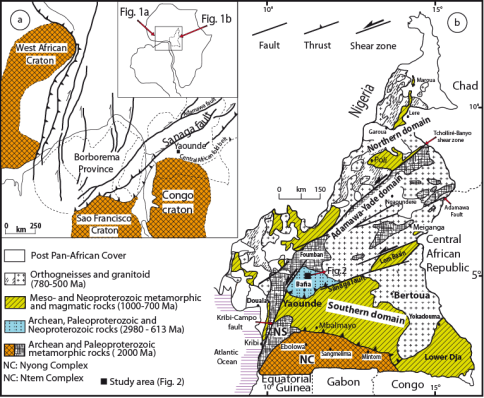
Figure 1. The Pan-African Belt of Central Africa: (a) Continent scale geodynamic reconstruction [30]; (b) Map of different lithotectonic units of Cameroon (modified from [38]).
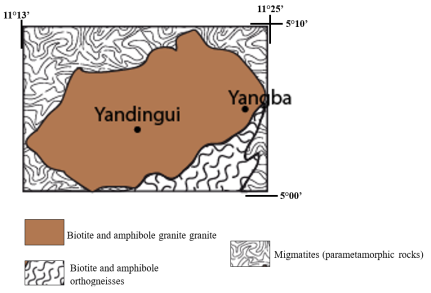
Figure 2. Geological map of Yandingui-Yangba.
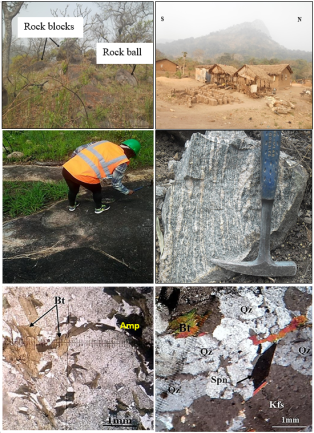
Figure 3. Photographs and microphotographs of granites and orthogneiss: a) outcrop in rounded shapes and blocks of granites in the Beka locality; b) panoramic view of the Yandingui massif; c) slab outcrop of orthogneiss; d) orthogneiss sample; e) Molding of white minerals by biotite; f) euhedral crystals of sphene and chloritization of biotite.
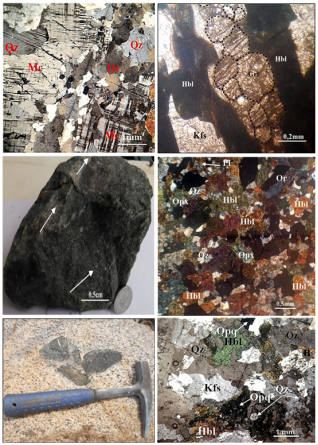
Figure 4. Microphotographs and photographs of orthogneisses, amphibolites and granites: a) microcline porphyroblasts in biotite and amphibolite orhogneisses; b) garnet aggregates parallel to green hornblende porphyroblasts; c) amphibolite sample; d) nematogranoblastic texture in amphibolites; e) outcrop of biotite and amphibolite granite with amphibolite enclaves; f) heterogranular granular texture in biotite and amphibolite granites.
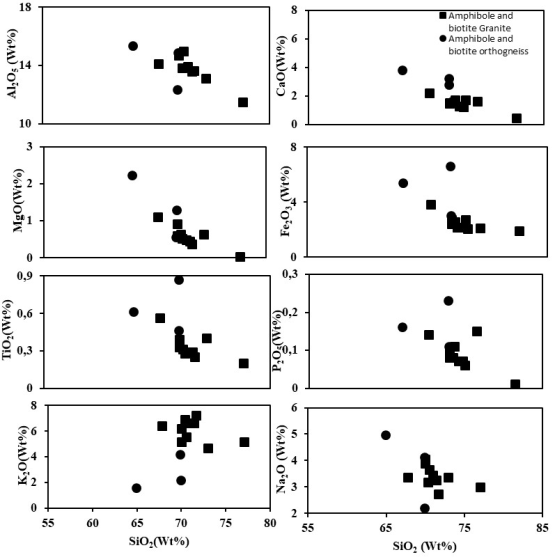
Figure 5. Harker type variation diagram for major elements as a function of SiO2 (% by weight).
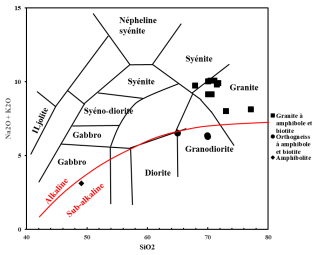
Figure 6. Nomenclature and geochemical classification of Yandingui-Yangba granites: TAS diagram by Cox et al. [3]; the red line marks the boundary between the alkaline and sub-alkaline domains according to Miyashiro [17].
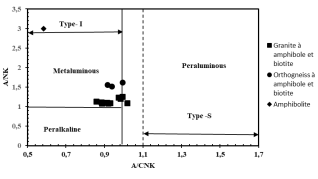
Figure 7. A/NK [Al2O3 / (Na2O + K2O)] vs. A/CNK [Al2O3 / (CaO + Na2O + K2O)] diagram according to Maniar and Piccoli [15]; the dashed line represents the boundary between Type-I granites and Type-S granites according to Chappell and White [2].
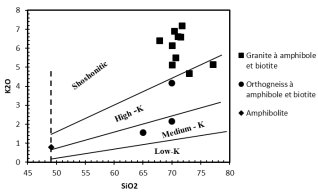
Figure 8. Peccerillo and Taylor [32] diagram.
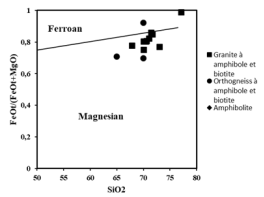
Figure 9. FeOt/ (FeOt + MgO) vs SiO2 diagram by Frost et al. [6], showing the magnesian affinity of granites and the magnesian-ferrous affinity of Nyandingui-Yangba orthogneiss.
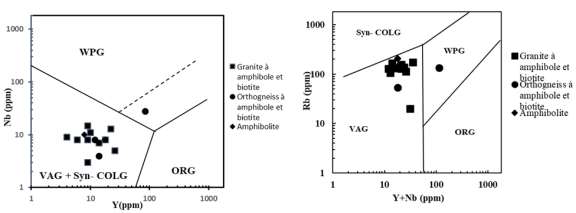
Figure 10. Geotectonic discrimination diagrams by Pearce et al. [31]: a) Rb/Y+Nb (ppm) diagram; b) Nb/Y (ppm) diagram. WPG: within-plate granites, ORG: ocean ridge granites, VAG: volcanic arc granites, Syn-COLG: syn-collisional granites.
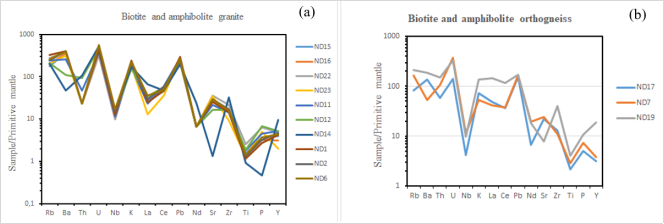
Figure 11. Trace element patterns normalized to the primitive mantle of McDonough and Sun [34]: a) Trace element patterns for Yandingui-Yangba granites; b) Trace element patterns for Yandingui-Yangba orthogneiss.
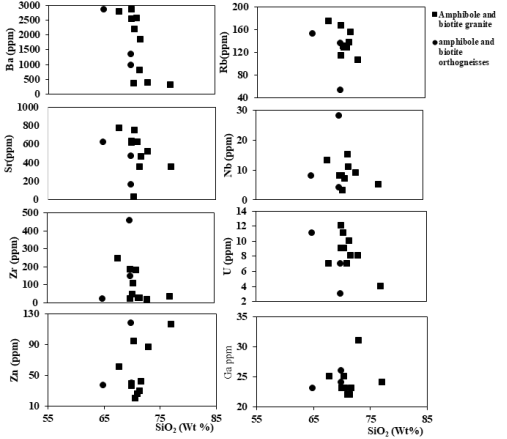
Figure 12. Harker type variation diagram for some trace elements as a function of SiO2.
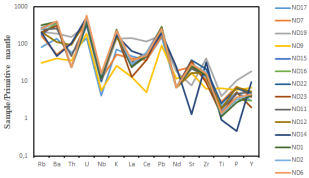
Figure 13. Trace element patterns of Yandingui-Yangba granites and orthogneiss, normalized to the primitive mantle of McDonough and Sun [34].
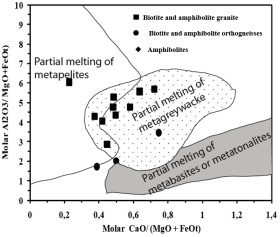
Figure 14. Molar diagram CaO/ (MgO + FeOt) / Al2O3/(MgO + FeOt) by Altherr et al. (2000).



 Share This Article
 Twitter
 Linked In
 Facebook
 Copy
Copy Download